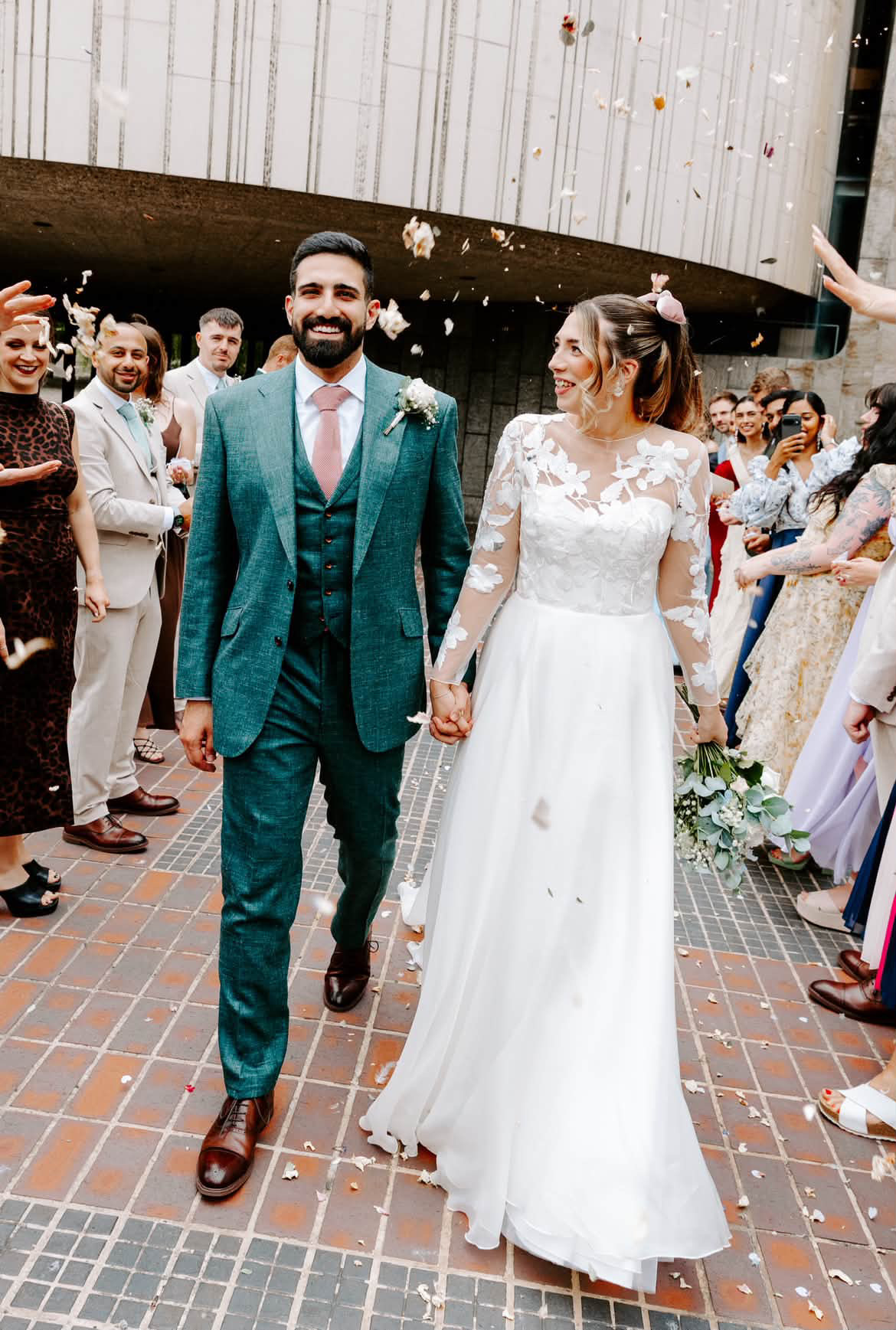
A wedding is one of the few occasions when people who rarely think about tailoring suddenly find themselves expected to have strong opinions about lapels, cloth weights, waistcoats and pocket squares.
It can be a lot.
There are photographs everywhere.
There are social media trends.
There are colour palettes.
There are opinions from friends, family and sometimes complete strangers.
Before long, it is very easy to end up choosing what a groom is apparently supposed to wear rather than what actually feels right.
A wedding suit should feel special.
But it should still feel like you.
Start with your own style
Before looking at wedding inspiration, think about the clothes you already feel good in.
Do you naturally wear darker colours?
Do you like texture?
Do you prefer clean, simple clothes?
Do you enjoy standing out?
Do you usually avoid anything too formal?
These things matter.
If you have spent your entire life avoiding bright colours, your wedding day may not be the ideal moment to discover a sudden passion for emerald green from head to toe.
Equally, if you love colour and personality, there is no reason your wedding suit should become an anonymous navy uniform simply because it is considered safe.
The best starting point is always the person.
Think about the wedding itself
Your suit does not exist in isolation.
It needs to make sense in the setting.
A relaxed countryside wedding creates different possibilities from a formal city ceremony.
A summer wedding abroad will require different cloth from a winter wedding in the UK.
Time of day matters.
Venue matters.
Season matters.
These things can guide decisions without dictating them.
The aim is not to match the curtains.
It is to create an outfit that feels at home in the wedding while still feeling personal.
You do not need to match your partner
Coordination is good.
Matching every detail is usually unnecessary.
Your suit should sit comfortably alongside what your partner is wearing, but it does not need to copy it.
If there is a particular colour running through the wedding, that can be picked up subtly through a tie, pocket square, lining or buttonhole.
Often the strongest wedding looks are coordinated rather than matched.
They feel connected without looking staged.
Do not become a supporting character at your own wedding
There is a tendency to treat the groom’s outfit as something that should quietly blend into the background.
We do not agree.
You are not a prop in somebody else’s photographs.
You are a co-star in the day.
That does not mean you need to wear something loud or theatrical.
It simply means your outfit deserves the same thought as every other important part of the wedding.
You should feel considered, confident and properly dressed for the occasion.
Choose colour carefully
Colour is often where people become nervous.
Navy and grey remain popular for good reason. They are versatile, flattering and easy to wear.
But they are not the only options.
Greens, browns, lighter blues and warmer neutrals can work beautifully depending on the season and setting.
The important question is not, “Is this fashionable?”
It is, “Will I feel comfortable wearing this?”
A colour can look fantastic on a hanger and still feel completely wrong once you put it on.
Your reaction matters.
Think beyond the wedding day
One of the best ways to choose a wedding suit that feels natural is to think about whether you would wear it again.
This does not mean the suit has to be boring.
It means making considered choices.
Could the jacket work separately?
Could the trousers be worn with knitwear or another blazer?
Would you wear the complete suit to a dinner, race day, another wedding or an important event?
If the answer is yes, there is a good chance you are choosing something that genuinely suits your style rather than simply dressing for a theme.
Fit has more impact than novelty
It is very easy to focus on the visible details.
The unusual lining.
The contrasting buttonhole.
The statement waistcoat.
The bold cloth.
Those things can all be enjoyable, but fit will have far more impact on how you look.
A beautifully fitted simple suit will almost always look better than an extravagant suit that does not sit properly.
The shoulders, jacket length, waist suppression, trouser rise and overall balance matter enormously.
Get those right first.
Then add personality.
Be careful with trends
Wedding trends move quickly.
Photographs last rather longer.
There is nothing wrong with taking inspiration from current styles, but think about whether you genuinely like the look or whether you simply keep seeing it.
There is a difference.
You do not need to make every choice timeless.
That can become just another form of playing safe.
But it is worth asking whether you will still recognise yourself in the photographs ten years from now.
Your wedding appointment should feel relaxed
You should not arrive at a wedding suit appointment feeling as though you need all the answers.
That is part of what the appointment is for.
Bring ideas if you have them.
Bring photographs.
Bring your partner if you want to.
Or arrive with absolutely no idea whatsoever.
A good tailor should help you work through the options rather than make you feel tested on your knowledge of menswear.
Sometimes the most useful thing a client can say is simply:
“I know what I don’t like.”
That is a perfectly good place to start.
The best wedding suit feels like an elevated version of you
That is ultimately the goal.
Not costume.
Not conformity.
Not dressing like somebody you found on Pinterest.
You, but sharpened.
You, but more considered.
You, in something that fits beautifully and feels appropriate for one of the biggest days of your life.
Because when you look back at the photographs, you should not just remember the suit.
You should remember how good you felt wearing it.