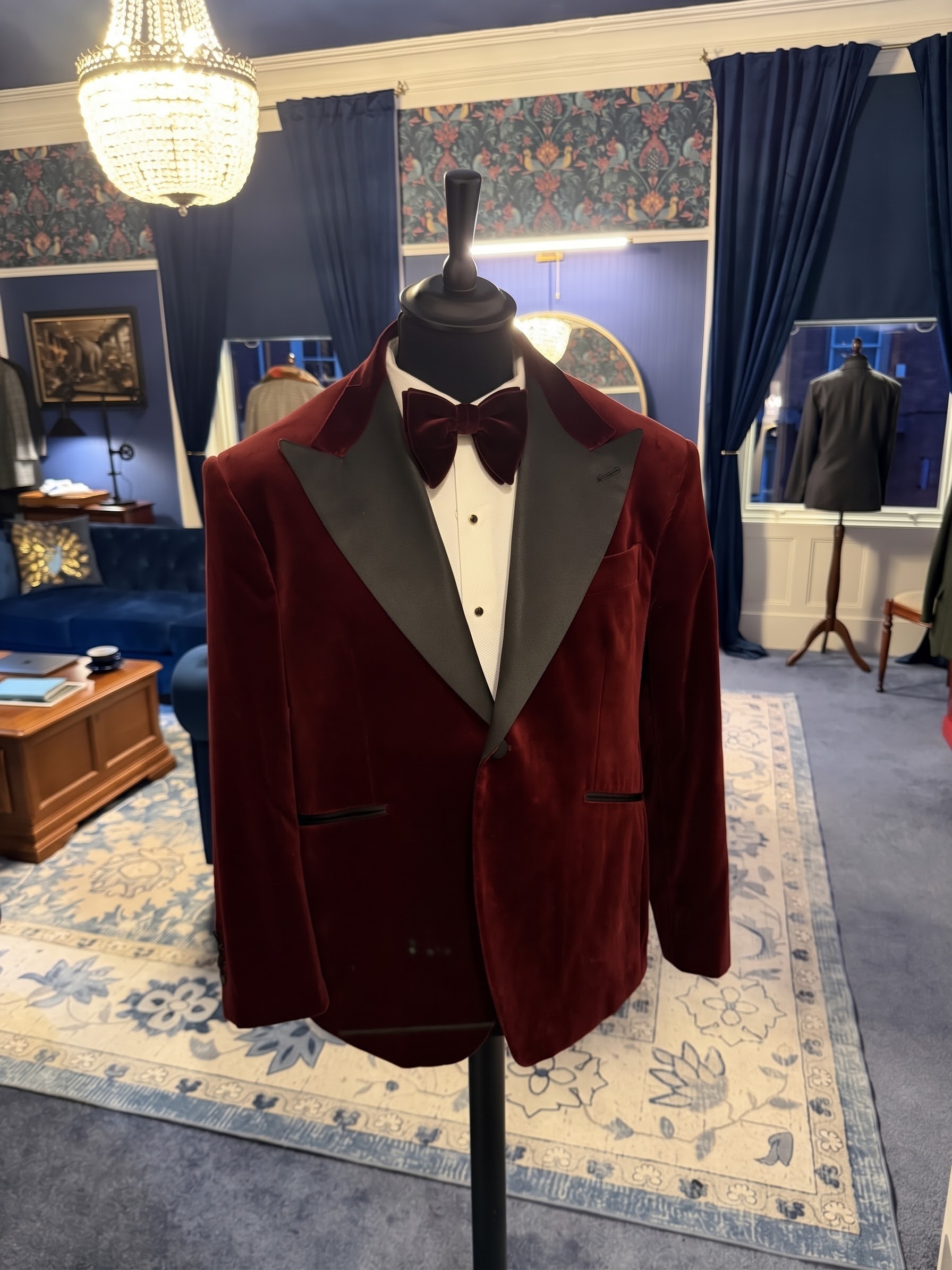
At first glance, the difference between an off-the-peg suit and a made-to-measure suit can seem fairly simple.
One is already hanging on a rail.
The other is made for you.
But the real difference goes much further than that.
It is about proportion, choice, fit and the relationship between the garment and the person wearing it.
What is an off-the-peg suit?
An off-the-peg suit is made to a standard size.
A manufacturer creates a block — essentially a standard pattern — and produces jackets and trousers in a range of sizes.
You then choose the size that comes closest to your body.
For some people, this works very well.
If your proportions happen to sit close to the manufacturer’s standard block, you may find something that fits reasonably well with only a few alterations.
The difficulty is that human bodies are not standard.
Two people with the same chest measurement may have completely different shoulder slopes, arm lengths, posture, waist proportions or trouser shapes.
That is where the limitations of ready-made clothing begin to show.
Made-to-measure starts with you
A made-to-measure suit begins with your measurements and your proportions.
Rather than asking your body to fit a standard garment, the garment is adjusted to fit your body.
That distinction matters.
Measurements such as chest, waist and inside leg are important, but they are only part of the picture.
A tailor is also looking at posture, balance and shape.
Does one shoulder sit slightly lower than the other?
Do you stand very upright?
Do you carry more weight through the stomach?
Are your arms proportionally long?
Do trousers usually pull across the seat?
These are the things that can make the difference between a suit that simply closes and a suit that actually looks right.
Fit is not about being tight
One of the biggest misconceptions around tailoring is that a well-fitted suit should be very close to the body.
It should not.
A well-fitted suit should look clean and balanced.
You should be able to move.
The jacket should sit properly across the shoulders.
The collar should remain close to the neck.
The front should fall cleanly rather than pulling.
The trousers should follow the shape of the body without clinging to it.
Good tailoring is often most noticeable because nothing looks wrong.
There are no obvious pulls, collapses or strange proportions distracting from the person wearing the suit.
You have far more choice
The other major difference is design.
With an off-the-peg suit, someone else has already made most of the decisions for you.
The cloth has been chosen.
The lapel width has been chosen.
The lining has been chosen.
The buttons have been chosen.
The trouser style has been chosen.
With made-to-measure, those decisions become yours.
You can choose the cloth, colour, pattern, lining, pockets, lapels, buttons, vents, trouser shape and a host of smaller details.
That does not mean you have to become a tailoring expert overnight.
A good tailor should guide you.
The point is not to present you with hundreds of options and leave you to struggle.
It is to understand what you want the suit to do and then help you choose the details that support that.
Cloth changes everything
Cloth is one of the areas where made-to-measure really comes into its own.
Different fabrics behave differently.
Some are light and soft.
Some are structured.
Some travel brilliantly.
Some are designed for warm weather.
Some are ideal for winter.
A navy suit made in a lightweight open-weave cloth will feel completely different from a navy suit made in a heavier flannel.
The colour may be similar, but the character of the garment changes entirely.
Choosing cloth with purpose makes a suit much more useful.
Made-to-measure can solve practical problems
Some people come to made-to-measure because they love clothes.
Others come because buying clothes has always been frustrating.
Perhaps jackets that fit across the chest are too large at the waist.
Perhaps trousers never fit properly through the thigh.
Perhaps one arm is longer than the other.
Perhaps standard sizing simply does not work.
This is where made-to-measure becomes less about luxury and more about practicality.
Clothing should not make you feel as though your body is the problem.
Sometimes the problem is simply that the garment was designed around somebody else’s proportions.
It is not the same as bespoke
Made-to-measure and bespoke are often used interchangeably, but they are not exactly the same thing.
Traditional bespoke tailoring usually involves a completely individual pattern created from scratch for one client, along with multiple fittings and a high degree of handwork.
Made-to-measure generally begins with an existing pattern that is then adjusted to suit your measurements and proportions.
For many clients, made-to-measure offers an excellent balance.
You get a highly personalised garment, a broad range of styling choices and a much more individual fit without necessarily moving into the cost and complexity of full bespoke tailoring.
Is made-to-measure worth it?
That depends on what you want from your clothes.
If you need a suit occasionally and can find an off-the-peg garment that fits you well, ready-made may be perfectly adequate.
But if you wear tailoring regularly, struggle with standard sizing, want something specific or are buying for an important occasion, made-to-measure can make a significant difference.
The value is not just in having something made.
It is in ending up with something you actually want to wear.
The goal is not simply a better suit
The best made-to-measure suit should not make people think, “That is an expensive suit.”
It should make them think you look good.
The shoulders sit correctly.
The proportions work.
The cloth suits you.
The colour feels right.
You look comfortable.
That is the real difference.
Made-to-measure is not about turning clothing into something complicated.
It is about making clothing work better for the person wearing it.