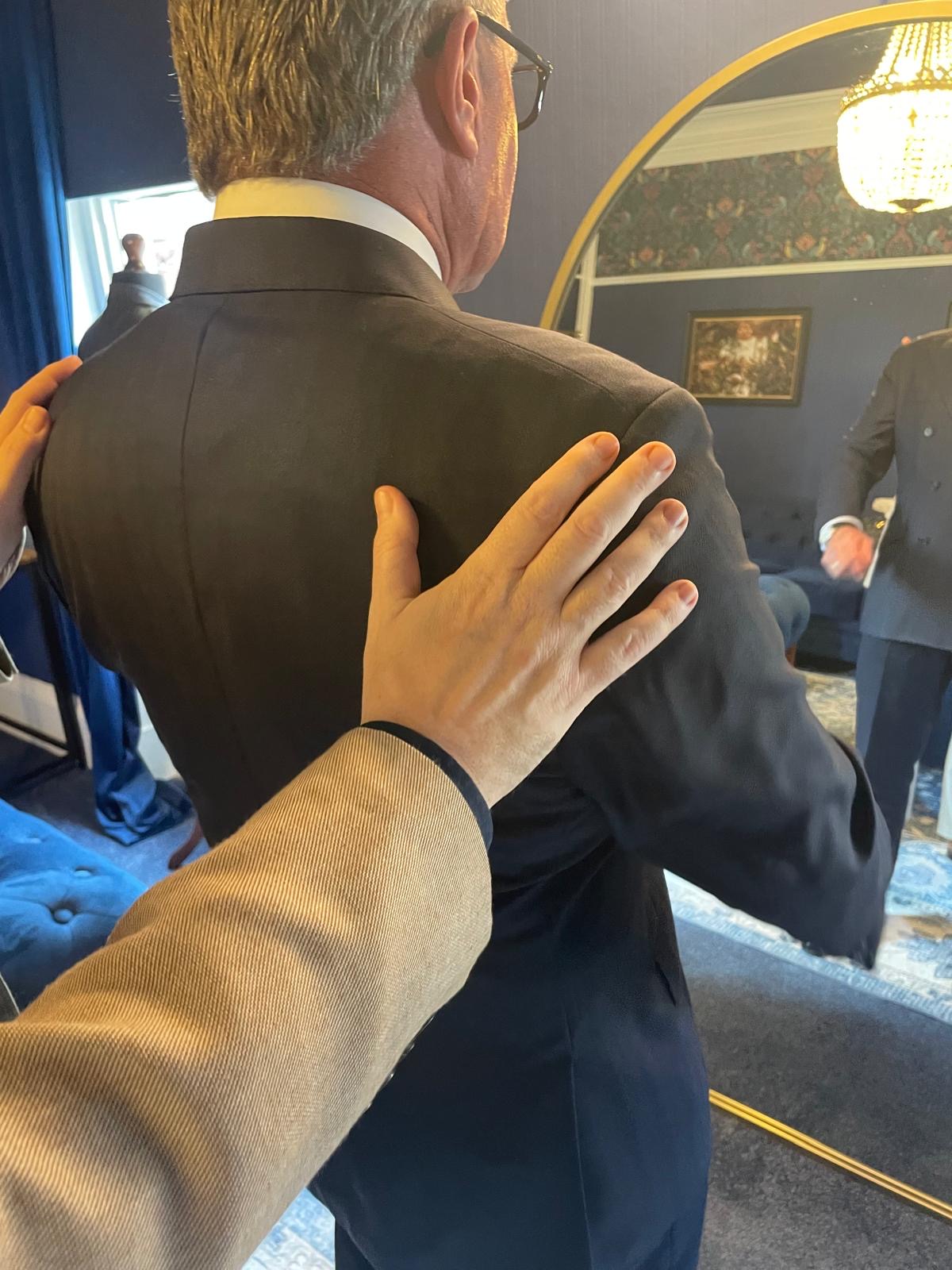
A well-fitting suit should not feel like a costume.
It should not be so tight that you are afraid to sit down, nor so loose that it looks as though you borrowed it from somebody else.
The best fit is usually the one that looks balanced, feels comfortable and allows you to move without constantly adjusting yourself.
That sounds simple.
In practice, there are a number of small details that make a very big difference.
Start with the shoulders
The shoulders are one of the most important areas of a jacket.
The shoulder seam should sit where your natural shoulder ends.
If it extends too far, the jacket can look oversized and collapse at the top of the sleeve.
If it sits too far in, the jacket may pull across the upper back and feel restrictive.
This is one of the hardest areas to alter significantly after a jacket has been made, which is why getting the shoulder balance right from the beginning matters so much.
The collar should sit cleanly
A jacket collar should sit neatly against the back of your shirt collar.
There should not be a large gap between the jacket and your neck.
Equally, the collar should not feel as though it is pushing into you.
A visible collar gap can be caused by a number of things, including posture, shoulder shape and the balance of the jacket.
It is one of those details that many people cannot immediately name, but they can usually tell that something looks wrong.
The chest should look clean
The front of the jacket should fall smoothly.
You should not see obvious pulling from the button.
If the fabric is straining across the chest or waist and creating deep horizontal lines, the jacket is too tight.
If there is a large amount of excess cloth around the chest, the jacket may be too loose.
The goal is not to make the jacket cling to the body.
It is to give the body shape without looking forced.
A fitted suit is not the same as a tight suit
This distinction is worth making because modern menswear has sometimes confused the two.
A fitted suit follows the shape of the body.
A tight suit fights with it.
If the lapels are bowing away from the chest, the button is pulling, the vents are opening or the trousers are creasing heavily across the front, the garment is probably too tight.
A suit should create a clean silhouette while still allowing you to breathe, sit, walk and move your arms.
You are meant to wear the clothes.
The clothes are not meant to immobilise you.
Jacket length matters more than people think
Jacket length has a huge influence on proportion.
Too short, and the jacket can make the body look unbalanced.
Too long, and it may overwhelm the wearer.
There is no single correct length for every person.
Height, leg length, torso length and personal style all matter.
The aim is to create proportion.
That is one of the reasons made-to-measure can be so useful. Two people who wear the same chest size may need very different jacket lengths to look balanced.
What about sleeve length?
A jacket sleeve should usually allow a small amount of shirt cuff to show.
How much is partly a matter of preference, but around half an inch is a common guide.
More important is consistency.
The sleeve should not swallow the hand, and it should not finish so high that it looks obviously short.
If one arm is slightly longer than the other, the sleeves should be adjusted individually rather than forcing both sides to match a standard measurement.
The jacket waist should shape the body
A good jacket should create some definition through the waist.
That does not mean it should be aggressively pinched in.
The amount of shape should suit the person.
Some people benefit from a stronger waist suppression.
Others look better with a straighter line.
The important thing is that the jacket works with the wearer’s natural proportions rather than imposing a fashionable shape regardless of body type.
Trousers should sit properly at the waist
Trouser fit is often overlooked because people focus so heavily on the jacket.
But badly fitting trousers can ruin an otherwise excellent suit.
The waistband should feel secure without digging in.
The trousers should not need a belt simply to stay up.
They should sit at the intended rise, whether that is higher or lower, rather than slipping down and creating excess fabric around the crotch.
A good trouser fit starts at the waist and works down.
The seat should be clean
At the back, the trousers should follow the shape of the body without pulling or sagging.
Horizontal lines across the seat often indicate that the trousers are too tight.
Excess folds can suggest too much cloth or an incorrect balance.
Again, bodies vary enormously.
Some people have a more prominent seat.
Others are straighter through the back.
The pattern needs to reflect the actual person rather than assume everyone is built the same way.
How much trouser break should you have?
Trouser break is the fold created where the trouser meets the shoe.
There is no single correct answer.
Some people prefer almost no break, creating a very clean, modern line.
Others prefer a slight or fuller break for a more traditional look.
What matters is that the length works with the trouser width and the style of shoe.
A narrow trouser with too much break can look untidy.
A wider trouser with no break at all can sometimes look too short.
Proportion matters more than following a rule.
Fit should look good when you move
This is something photographs do not always show.
A suit needs to work when you are standing, but also when you are walking, sitting, greeting people and moving through your day.
If a jacket only looks good when you stand perfectly still with your arms by your sides, it is not doing its job.
The same applies to trousers.
You should be able to sit comfortably.
You should not feel constant pulling across the thigh or knee.
The best tailoring balances appearance with movement.
Small adjustments can make a big difference
Sometimes a suit does not need dramatic work.
A sleeve shortened slightly.
A trouser taken in through the waist.
A jacket waist refined.
A trouser hem adjusted.
These small changes can completely alter how the garment looks.
That is why fit is not simply about the size label.
It is about how the garment sits on the individual.
The best fit should not distract from you
When a suit fits well, people rarely analyse every detail.
They simply think you look good.
The shoulders look clean.
The jacket hangs properly.
The trousers sit naturally.
The proportions feel right.
Nothing is fighting for attention.
That is the real goal of fit.
Not tightness.
Not fashion for the sake of fashion.
Just clothes that work with the person wearing them.