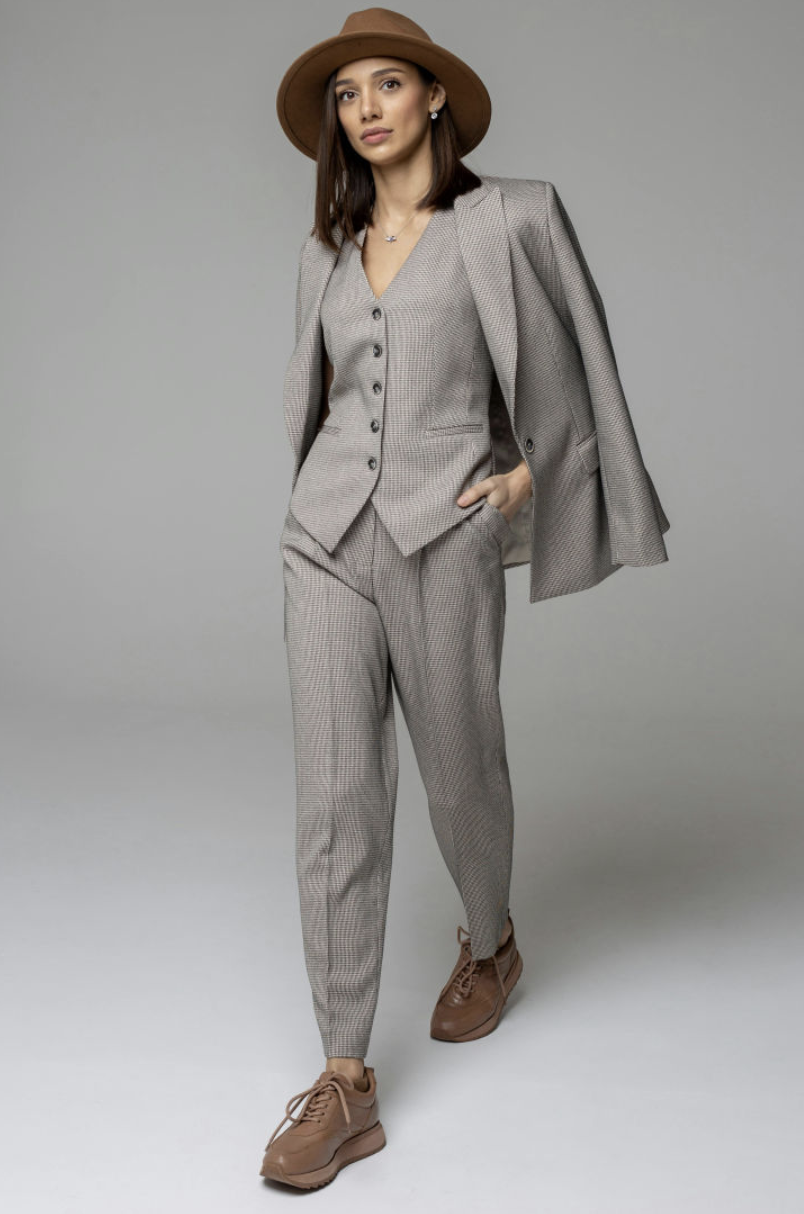
A good suit should be built around the person wearing it.
That sounds obvious.
But women’s tailoring has often been treated as though the answer is simply to take a traditional menswear shape, make it smaller and hope for the best.
That rarely produces the best result.
Women’s bodies vary just as widely as men’s, and often in different ways.
Bust, waist, hip, shoulder, rise and proportion all affect how a jacket and pair of trousers need to be cut.
The solution should not be to force the body into the clothes.
The clothes should be designed around the body.
Women are not simply smaller men
Traditional suit patterns were largely developed around male proportions.
That means broader assumptions about shoulder width, chest shape, waist placement, hip shape and trouser fit.
For some women, adapting that kind of pattern works reasonably well.
For others, it does not.
A fuller bust may require additional shaping through the front of a jacket.
A defined waist may need very different suppression.
Wider hips may change how both the jacket and trousers need to balance.
The answer is not simply to reduce the measurements.
The whole shape needs to be considered.
The bust changes jacket balance
One of the biggest differences in women’s tailoring is the relationship between the bust and the rest of the jacket.
A jacket that fits through the shoulders may pull across the bust.
A jacket that closes comfortably at the bust may then become too large through the waist.
This is one of the most common frustrations with ready-made tailoring.
A properly considered pattern allows room where it is needed without creating unnecessary volume everywhere else.
That is what gives the jacket a cleaner, more flattering line.
Waist position matters
Women do not all carry their natural waist at the same point.
Some have a shorter torso.
Some have a longer torso.
Some have a very defined waist.
Others have a straighter silhouette.
The waist suppression of a jacket needs to sit in the right place.
If it is too high or too low, the whole jacket can look wrong even if the basic measurements are technically correct.
Good tailoring is as much about vertical proportion as it is about circumference.
Hip shape affects jacket length
Jacket length can completely change how a suit looks.
A cropped jacket may suit one person beautifully.
Another may benefit from something longer and cleaner.
If the jacket finishes at the widest point of the hip, it can exaggerate width.
Move it slightly higher or lower and the whole silhouette can change.
There is no universal ideal length.
It depends on height, torso length, hip shape and personal style.
This is where individual fitting becomes far more useful than following a standard block.
Trousers need just as much attention
Trouser fit is often where women struggle most with ready-made suiting.
A waistband may fit but the hips do not.
The hips may fit but the waist gaps.
The thighs may feel tight while the rest of the trouser feels too loose.
The rise may be completely wrong.
These are not unusual bodies.
They are simply bodies that do not match the assumptions built into a standard-size pattern.
Made-to-measure allows the trouser to be shaped around those proportions rather than forcing one measurement to dictate the rest.
Rise can change everything
Trouser rise has a huge effect on both comfort and appearance.
A higher rise can create a longer leg line and sit more naturally at the waist.
A lower rise may suit some styles, but it can also create pulling or slipping if it does not work with the wearer’s proportions.
The rise should be chosen deliberately.
It should not simply be whatever the manufacturer decided was fashionable that season.
Shoulder structure should suit the wearer
Not every woman wants a soft, unstructured jacket.
Equally, not everyone wants strong shoulders.
The amount of structure should suit both the body and the intended style.
A little shoulder definition can create balance.
Too much can overwhelm a smaller frame.
Too little can sometimes leave the jacket looking flat.
The goal is not to make the wearer look more masculine or more feminine.
It is to create proportion.
Women’s tailoring does not need to mean “feminine”
This is important.
A woman’s suit does not have to be softened, shaped or decorated simply because it is being made for a woman.
Some clients want a strongly tailored, traditionally masculine silhouette.
Others want more shape.
Some want a fitted waist and wide-leg trouser.
Others want a straighter jacket and relaxed fit.
There is no single correct version of women’s tailoring.
The whole point of made-to-measure is that the design starts with the person.
Cloth should be chosen for the garment, not the gender
Women should have access to the same quality and variety of cloth as men.
Wools, flannels, worsteds, tweeds, linens, cottons and blends can all work beautifully in women’s tailoring.
The choice should depend on how the garment will be worn, the season, the desired drape and the client’s personal taste.
A beautifully cut suit in a serious tailoring cloth should not be restricted by the label on the department it came from.
Fit should feel empowering, not corrective
There is sometimes an unfortunate idea in women’s clothing that garments should be chosen to “hide” or “fix” the body.
That is not how we think about tailoring.
The body is not a problem to solve.
Tailoring is about proportion, balance and comfort.
It is about making the garment work properly so the wearer does not spend the day thinking about what is pulling, gaping or sitting badly.
A well-fitting suit should make you feel more like yourself, not more self-conscious.
The details still matter
Once the fit is right, the design choices become the enjoyable part.
Lapel shape.
Button position.
Pocket style.
Trouser width.
Waistcoat or no waistcoat.
Single-breasted or double-breasted.
Cloth.
Lining.
Buttons.
These details allow the suit to become personal.
But they work best when the underlying fit has already been properly considered.
The best women’s tailoring should not feel like an adaptation
That is really the point.
A women’s suit should not feel like a menswear suit that has been reluctantly altered.
It should feel intentional from the beginning.
The proportions should make sense.
The jacket should sit properly.
The trousers should work with the body.
The design should reflect the person wearing it.
Because good tailoring is not about gendering a garment.
It is about understanding the person inside it.